
1. Overview
This project analysed Scottish GDP growth using a range of macroeconomic indicators to better understand the key drivers of economic performance and assess the feasibility of forecasting GDP in a real-world policy context.
The analysis combines Scottish economic data with external market indicators including oil prices and exchange rates and applies multiple modelling approaches. These include full and reduced multiple linear regression models, a lagged regression model, a decision tree model, and an ARIMA time-series model. The aim is not only to identify relationships between variable but also to evaluate the strengths and limitations of different modelling approaches.
A central objective of the project is to demonstrate a structured analytical process from data collection and preparation to modelling, diagnostics, and interpretation, while recognising the inherent challenges of forecasting macroeconomic outcomes.
2. Data and Methodology
The dataset brings together a range of macroeconomic indicators relevant to Scottish GDP growth, including:
- GDP growth rate
- Unemployment rate
- Inflation (CPI)
- Earnings growth
- Retail activity (proxy for consumption)
- Oil and gas production
- Output per job (productivity measure)
- Brent crude oil prices
- GBP/EUR exchange rate
To ensure meaningful analysis, I transformed several variables into year-on-year growth rates. This reduces the impact of long-term trends and allows the models to focus on short-term economic dynamics.
Multiple modelling approaches were applied:
- Full multiple regression to assess the combined impact of all variables
- Reduced regression to improve interpretability
- Lagged regression to capture delayed economic effects
- Decision tree model to test non-linear relationships
- ARIMA model as a benchmark based solely on past GDP values
This multi-model approach allows for comparison across different analytical frameworks and avoids reliance on a single method.
3. Key Findings
3.1 Productivity is the strongest driver of GDP growth
Across all regression models, I found that output per job growth emerged as the most consistent and statistically significant variable. This suggests that productivity plays a central role in driving Scottish economic growth.
This finding aligns with economic theory where improvements in efficiency and output per worker contribute directly to overall economic expansion.
3.2 Domestic demand contributes to growth
Retail growth, used as a proxy for consumption, is statistically significant in the full regression model. This indicates that stronger consumer activity is associated with higher GDP growth.
This reinforces the importance of domestic demand as a component of economic performance.
3.3 External factors have a measurable but variable impact
In the reduced model, Brent oil price growth is statistically significant, suggesting that external energy market conditions may influence Scottish GDP.
However, this effect is less consistent when additional variables are included, indicating that external factors possibly interact with domestic conditions in complex ways.
3.4 Simple macroeconomic models are insufficient
A model using only unemployment and inflation explains very little of the variation in GDP growth. This highlights that:
- GDP is influenced by multiple interacting factors
- overly simplified models can lead to misleading conclusions
3.5 Model choice matters
The decision tree model performed significantly worse out of sample than insample, with negative test R-squared values. This indicates overfitting, as the model seemed to capture noise rather than meaningful patterns.
Decision trees aside, the regression models provided much more stable and interpretable results.
This demonstrates that:
- more complex models are not always better
- model selection must consider data size and structure
4. Model Performance and Comparison
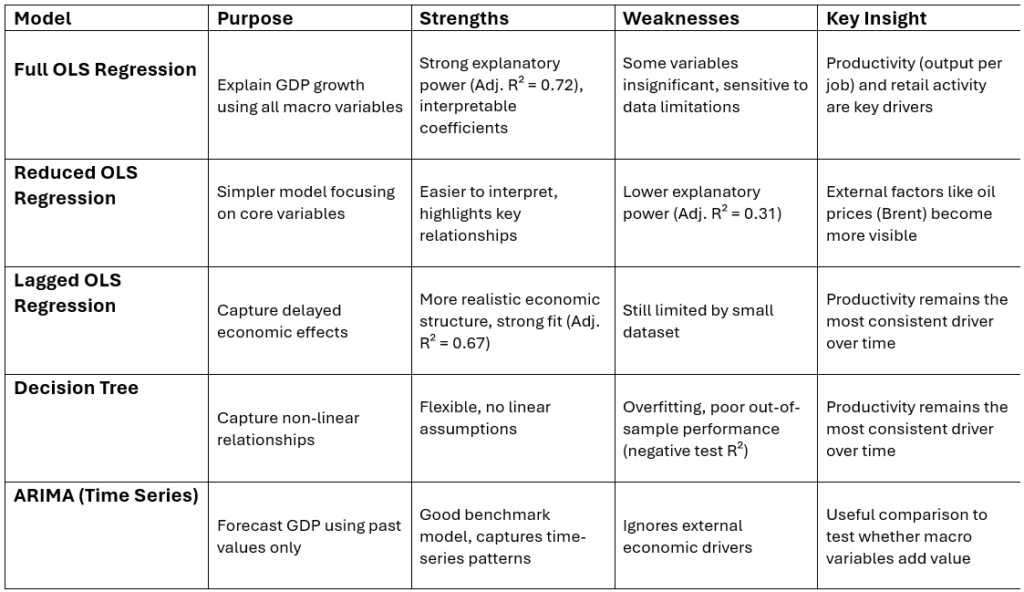
Overall, regression-based approaches were more reliable for this project, especially when we consider the limited size and frequency of the dataset.
5. Limitations
Several limitations affect the results and should be considered when interpreting the findings:
Small dataset
The analysis is based on annual data with only 25 observations. This reduces statistical power and increases sensitivity to individual years.
Structural shocks
Events such as the financial crisis and COVID-19 introduce volatility and disrupt stable relationships between variables making forecasting more difficult and less reliable.
Variable overlap
Some variables such as output per job and GDP are closely related economically. This requires careful interpretation of results to avoid overstating causal relationships.
Forecasting difficulty
The poor out of sample sample performance of the decision tree model highlights the challenges of predicting GDP growth, particularly when data is limited and relationships are unstable.
Data frequency
Annual data may mask short-term fluctuations that would be captured in higher frequency datasets such as quarterly data.
6. Conclusions
This project demonstrates that Scottish GDP growth can be analysed effectively using structured statistical methods and a combination of macroeconomic indicators. The results highlight the importance of productivity, domestic demand, and to a lesser extent, external economic conditions.
At the same time, the analysis shows that forecasting GDP is inherently challenging. While models can identify relationships and provide insights, their predictive performance is constrained by data limitations, structural changes, and economic complexity.
Overall the project demonstrated how data-driven analysis, combined with economic reasoning and critical judgement, can be used to support understanding and decision-making in a fiscal and policy context.